




Features of a good quality Pond Pressure Filter
Before we understand the features, just so you know, there are three types of Pond Filtration systems available in the market.
- Underwater Pond filters: This type of filter is ideal for small to medium sized ponds up to 15,000 litres with low fish stocking levels. This compact unit is easy & quick to install and will usually come with a built-in UV clarifier.
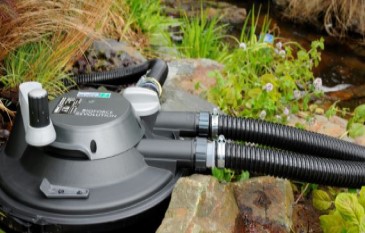
- Pressure filters (or Pressurised Pond filters): These are cylindrical shaped cannisters with lockable lids. This type of unit require water to be pumped to the unit and are suitable for medium sized ponds up to 30,000 litres. The water exits the unit at pressure. Hence the filter can be placed at a small distance away from the pond. The outlet water could also be used to feed a waterfall at a higher level.
- Gravity filters (or Flow Through Box filters): This type of filters is suitable for medium-sized to large ponds and Koi ponds. Unlike pressure filters, water exits this type of filter by gravity. Hence this type of units needs to be placed at the highest point in the system (for instance, top to the waterfall) for water to return via gravity to the pond.
Now, let us see what are the features of a good quality Pond Pressure Filter?
Adequate water filtration mechanisms:
A good quality Pond pressure filter will have 3 levels of water filtration mechanisms:
- Mechanical filtration: This type of filtration removes the larger (courser) sediments in the water.
- Biological filtration: In this type of filtration the beneficial nitrifying bacteria convert ammonia and nitrite from fish waste or uneaten fish food into harmless nitrate. The filter sponge offers the required surface area for the beneficial bacteria to colonise.
- UV filtration: This type of filtrations water is made to pass through a tube that houses an ultraviolet bulb which results in eliminating the suspended algae.
Note: It is important to know that pond filtration cannot prevent growth of Blanketweed as this type of Algae grows on the pool side and does not travel through the pond filter.
Water quality and waste management:
Accumulation of solids from fish waste or uneaten fish food will result in denitrification, which will cause ammonia concentrations to spike, causing fish getting killed overnight. This can be prevented by reducing feeding, removal of solid builds up, or performing a water refresh (never more than one quarter of the total pond volume) if ammonia concentrations become too high. Solid waste removal in a filter unit takes place through backwashing, whereby water is pumped backwards through the filter media. A good quality pressure filter will offer the user a convenient way to clean the filter foams.
Recommendations:
- Never use tap water to clean the filter sponges, as the chlorine in the tap water will destroy beneficial bacteria. Filter sponges must be cleaned in the water taken from the pond.
- Allow the beneficial bacteria time to culture after installing the new filter unit. This period is usually between 30 to 45 days but is lower in higher temperature ambience. The time needed for cultivation of beneficial bacteria can be reduced by adding Beneficial bacteria starter kit.
Pairing with suitable pond pump & Pond volume:
To maintain healthy water ecosystem, water should be circulated at least once every two hours. It is important that the pond pump’s flow rate does not exceed the pond filter’s maximum output capacity. If the pump’s flow rate is too large, then it can damage the seals of the pressure filter and will also prevent the pond water from spending adequate amount of time within the filter unit. While if the pump’s flow rate is too low, then it will result in ineffective cleaning of water. Hence, Filter capacity and the suitable pump should be chosen based on volume of water that needs to be cleaned. A good quality filter unit will have inlet, outlet and sludge connections suitable for multiple standard hose sizes for flexibility of use.
As a rule of thumb, the below calculation could be used to choose a suitable Pond Pump:
- Ponds with no fish: Max flow rate of the pond pump (LPH) = Pond volume (L) / 1.75
- Ponds with small (non-Koi) fish: Max flow rate of the pond pump (LPH) = Pond volume (L)
- Koi Ponds: Max flow rate of the pond pump (LPH) = Pond volume (L) / 0.5
Recommendations:
- The drop in the submersible pump’s flow rate, due to the height difference between the pump and filter location, must be considered while choosing a suitable pump for the filter.
At Rock Around The Block, we stock a comprehensive range of high quality Pond Filters and Pond pumps of wide capacity range from established brands that have proven to give long term reliability and ease of use. Descriptive product information, that have been put together after extensive product study, will assist you to choose the unit most suitable for your project. We offer competitive pricing coupled with secure & hassle-free delivery to your doorstep. We ship to all over Australia & New Zealand using Australia Post and offer same day pick up from our warehouse for paid orders.
Still need some help? Please call our friendly team at 1300 733 113 for technical expertise.